
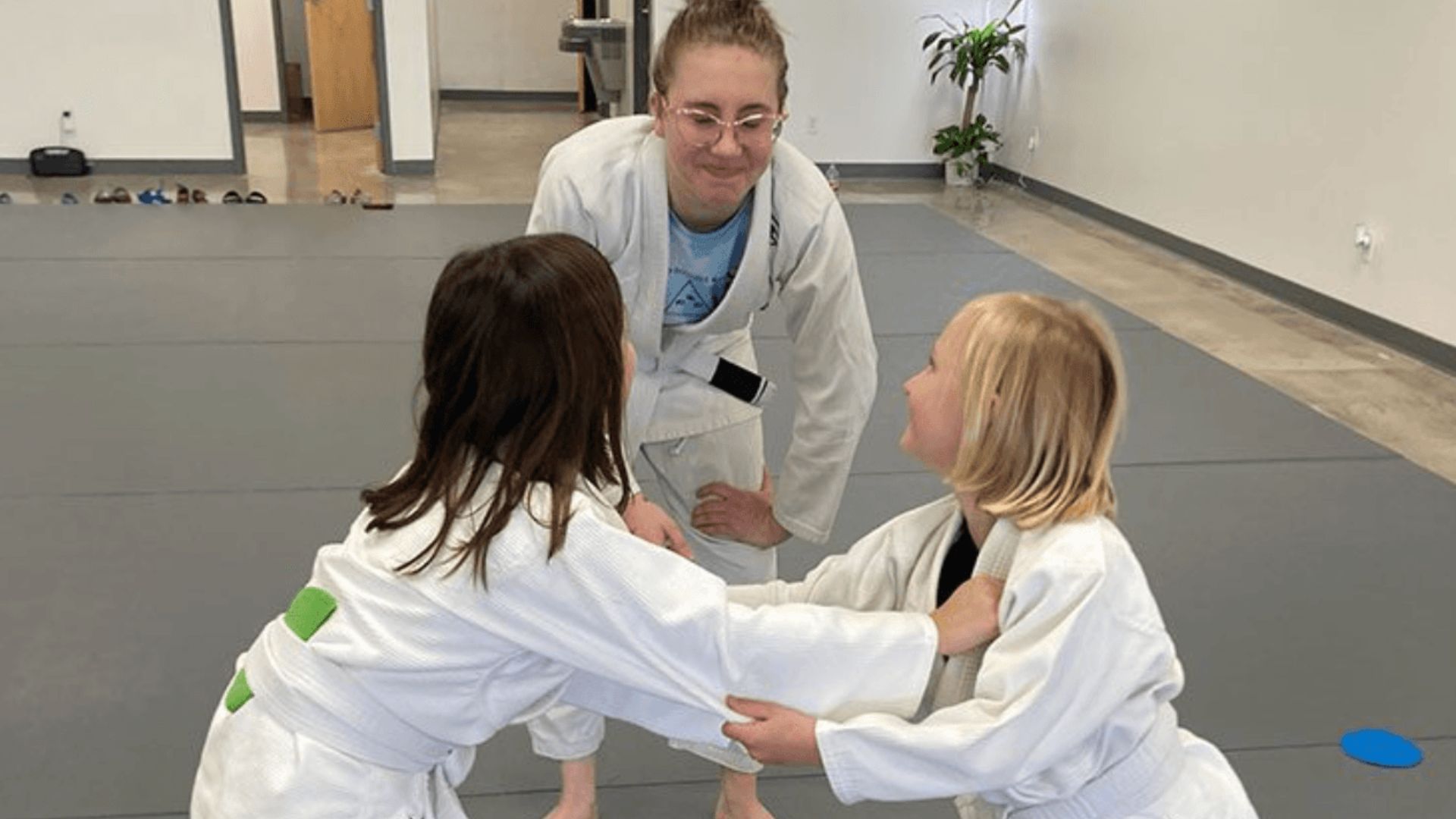
Most parents who ask this question are not really asking about Jiu Jitsu. They are asking something closer to: how do I get my child off a screen, into their body, and actually focused on something real? That concern is completely fair. Kids today are spending more time on tablets and phones than on anything physical, and schools are offering less and less in the way of movement and activity. Parents are looking for something that builds focus and concentration, but also gets their child genuinely moving and engaged. Jiu Jitsu, done well, addresses both of those things at once.
What follows is a plain look at what kids actually develop on the mat, based on how we run things at Odyssey Jiu Jitsu.
Learning to listen when it actually matters
One of the first things kids learn at Odyssey is something we call the listening position. It is a specific way to sit, with legs and arms positioned so they are not interfering with other students, and with eyes on the instructor. It sounds simple, but for a lot of kids, it is genuinely new. Having a physical posture tied to the act of paying attention gives them something concrete to do, rather than just being told to focus.
We also keep instruction short and sharp. Kids take in information better when they can hear something and then immediately do it with their bodies. If a child is not following along, instructors do not just repeat themselves louder. They get down to the child’s eye level, make eye contact, communicate clearly what is needed, and then look for the moment when the child gets it right so they can reinforce it. A lot of the behavioral habits we build in class come from catching kids doing the right thing and praising them in front of the group. That tends to bring the rest of the class along naturally.
How kids get comfortable losing (and why that skill travels)
Feeling like you have lost at something is never easy, and that is true for kids as much as adults. At Odyssey, we teach a lot of Jiu Jitsu through games, which changes the experience of losing considerably. When a child is having fun in the moment, they are not as attached to the outcome. The loss does not land the same way it would in a more formal competitive setting.
When a child does get upset, coaches are quick to step in with support and encouragement to get them back into the activity. The message is consistent: losing is part of the process, and what matters is what you take from it. That is not a complicated idea, but kids need to experience it repeatedly before it actually sticks. The mat gives them a low-stakes place to practice that, over and over, in a context that is still fun.
Body awareness and physical confidence built through repetition
In the first few months, kids learn how to move their bodies in ways most of them have never tried before. Falling safely, rolling, moving on the mat with control and coordination. These are not dramatic skills, but they build something real. Kids who learn how to fall without panicking, and how to move their bodies deliberately, carry that physical confidence into other areas of their lives.
Physical contact with teammates is also part of it. Jiu Jitsu is a contact sport, and for many kids, learning to be comfortable with that kind of physical engagement is its own development. It is not about aggression. It is about being at ease in your own body and not flinching away from the physical nature of competition. Parents often notice this shift at home and at school before they notice any change in belt rank.
Respecting teammates, not just rules
The kids program at Odyssey is built around fun and friendships first. We want healthy competition, but we also want kids to lift each other up. That combination, competing and supporting at the same time, is harder to find than it sounds, and it builds a culture that is genuinely good for kids to be part of.
There are rules and expectations in the program, and they matter. But the rules exist to protect the culture, not just to keep order. When kids understand that the expectations are there so everyone can train safely and enjoy themselves, they tend to buy into them more readily. The relationships and communication skills that come out of that environment are ones that carry well beyond the mat.
What progress looks like at ages 5 through 12
Kids in this age range develop at very different rates, and we treat them as individuals rather than running everyone through the same timeline. We have seen highly focused five-year-olds pick up skills faster than some eleven-year-olds. We have also seen older kids come in who need more time and more nurturing before things start to click. Neither of those situations is a problem.
Progress is coached individually, through games and structured learning, at a pace that suits the child. Belt ranks are part of the picture, but they are not the whole picture. The more visible signs of progress, better listening, more physical confidence, easier friendships with teammates, tend to show up well before any formal milestone.
When to know your child is ready to start
If your child is ready to have fun and learn some practical skills, they are probably ready. The one thing that does matter is a basic ability to follow simple instructions and pay attention for short periods. That is not about being a perfect student. It is about safety for everyone on the mat.
We recommend any child aged five or older come in for a free trial class at Odyssey. That gives your child a chance to experience the environment, and it gives you a chance to see whether it is a good fit before committing to anything. Most kids leave that first class wanting to come back. That is usually a good sign.
If you have questions before booking, feel free to get in touch with the team at Odyssey Jiu Jitsu directly.
