
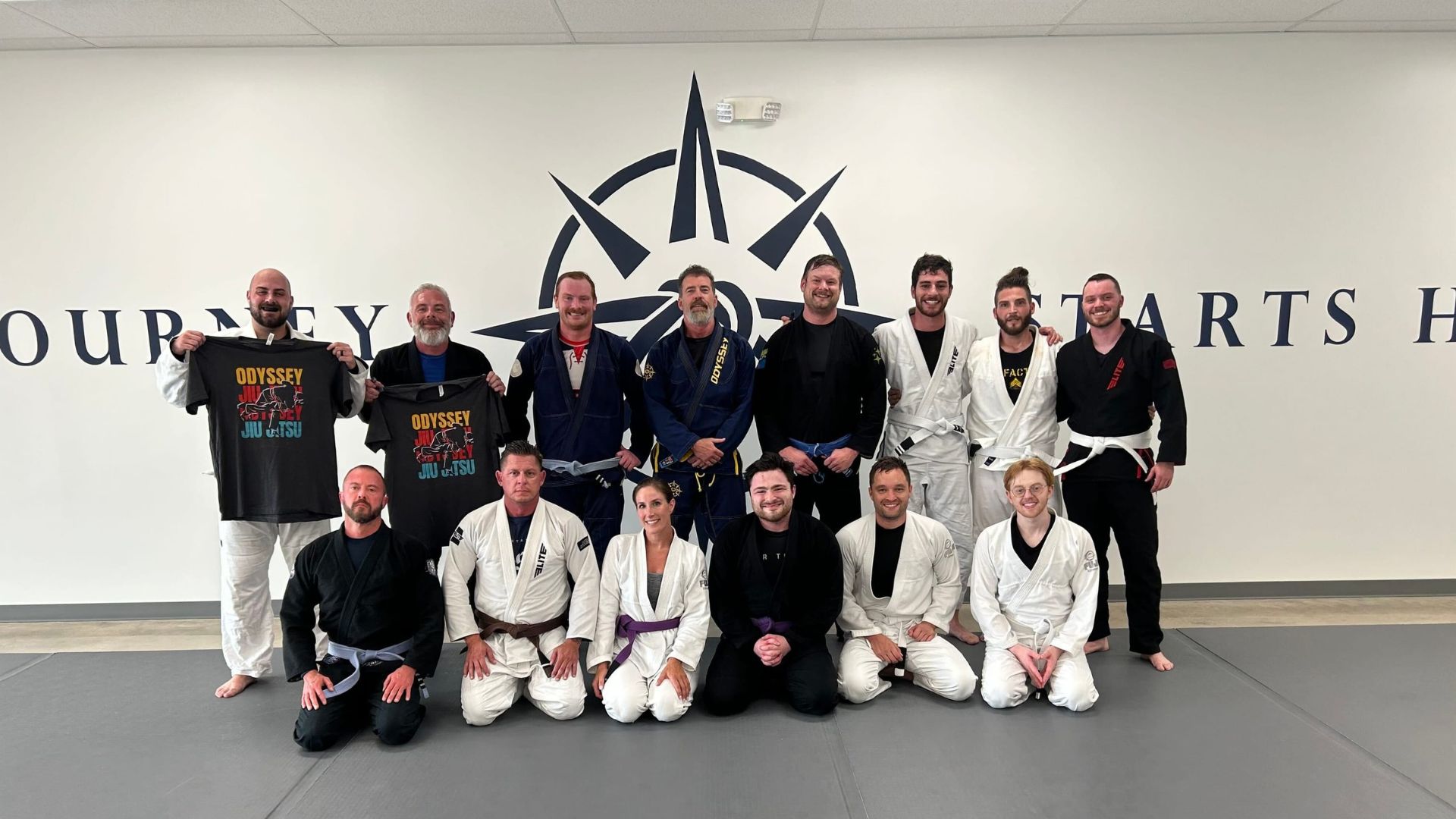
If you searched for a springfield fight club, we get it. But that’s not what Odyssey Jiu Jitsu is. We are a place where ordinary people from Springfield learn to protect themselves, get fitter and make friends along the way. This article walks through the first three months of training with us and the small goals that make more sense than big ones.
Why big goals tend to backfire in the first few months
Some beginners show up with the wrong goal: they want to learn to fight. The first goal should be to learn how to survive and defend yourself. At Odyssey, our goal is to help someone learn how to not have to fight.
If they did have to fight, they would be using Jiu Jitsu to protect themselves and control the other person, doing the minimum amount of damage to an aggressor as possible. That is a long way from wanting to be “good” fast, so the goals below are all about showing up and learning, not results.
Month one: show up and get used to the room
In the first few weeks you will be learning our Beginners Curriculum. It focuses on fundamental techniques that would work in a fight or in sport.
Aim for three classes a week. Every class is one hour and one of our coaches leads it. The beginner curriculum is 23 lessons that run in order on the timetable, so you can join any class and pick up where the group is. You don’t have to wait for a new course to start.
A first class starts with a short warm up of solo drills. Then the coach teaches one standing technique and one ground technique, like escaping a grab or holding someone down. You practice each one slowly with a partner and add a little resistance as you get comfortable. You can train in a gi or no gi. Sparring happens in separate 30 minute sessions after certain classes, and no one is pushed into it in month one. We usually encourage it once you have two stripes.
Three goals for month one:
- Attend 12 classes, three a week, and track them on your class card or in the Wodify app.
- Learn the room: where the class cards and cubbies are, how to book, and the names of three training partners.
- Bring a friend to a free Wednesday class, any time slot.
Everyone feels clumsy at the start, including every black belt on our mats. You’re not expected to be good yet. You’re expected to show up. Go at your own pace, tap early, and ask questions. Most people find it clicks somewhere around their tenth class.
Month two: learn the basics and let them feel clumsy
By month two you will have seen most of the core positions in the beginner curriculum: standing self defense (escaping grabs and headlocks, safe takedowns and falling), mount, guard and side mount. Each class still pairs one standing technique with one ground technique. You will start to see lessons come around again, which is the point. The second time through, the details start to stick. Examples include the trap and roll and the elbow escape from the bottom of mount, and escaping a headlock from standing.
The coach shows the technique, breaks it into a few key steps, then you drill it with a partner. We start slow with a cooperative partner, then add a little resistance, then drill it from the position it would really happen in. We keep it to two techniques per class so you get more reps, not more moves.
Clumsy looks like forgetting which arm goes where. Getting the first step right and losing the rest. Running out of breath in a drill that looks easy. Feeling like everyone else gets it faster. All of that is normal. What I tell people: “You’re not behind. Clumsy is what learning looks like.” And: “Count your classes, not your mistakes.”
On training safely: tap early and tap often. There is no prize for holding on. Your partner’s safety is your job too, so go slow, especially with submissions. If a partner is going too hard, ask them to slow down, or tell the coach. Coaches watch every drill and will step in. Sparring is optional and separate, and we encourage it once you have two stripes, not before.
Month three: notice what has gotten easier
If you have kept to around three classes a week, by month three you are close to 40 classes, which is our marker for a first stripe. The changes coaches notice are small. You walk in and know the warm up without watching someone else. You remember the first two or three steps of a technique when it comes around again. You stay calm on the bottom instead of pushing and burning out. Your breathing settles. You tap early without feeling embarrassed. You start helping the new person next to you find their spot on the mat.
Many beginners think progress means beating people in sparring or “winning” rounds. It doesn’t. At this stage progress is feeling more comfortable, remembering more, and recovering faster. Comparing yourself to someone who has trained for years, or to someone who joined with a wrestling background, tells you nothing. Compare yourself to who you were on day one. If something that confused you in month one now feels normal, that is real progress. Keep counting your classes, and the skill follows.
How to join a our community without feeling out of place
You start by emailing Kim, our General Manager, at odysseyspringfield@gmail.com to book a free trial class. There is no front desk, so you get a real person from the first message. The coach running the class meets you, shows you where things go, and pairs you with a partner for the drills. After the class you get our Welcome to Odyssey handbook, which covers how the beginner program works and what to do next. If you want more confidence before joining group classes, you can book a one hour Introduction to Jiu Jitsu session with an instructor first. The room is focused but friendly. People are there to learn and look after each other, not to prove anything.
We just celebrated one year in our location on South Campbell Avenue. Here are the worries we hear most, and how I answer them:
- “I’m too old.” We have members across a wide range of ages, and I’m 48 and still training. Jiu jitsu adapts to your body.
- “I’m not fit enough.” You don’t get fit to start jiu jitsu. Jiu jitsu gets you fit. Go at your own pace.
- “I’ve never done anything like this.” Nearly everyone starts with no experience. Our curriculum is built for exactly that.
- “I’ll get hurt.” We teach safety first: tapping, partner care, controlled drilling, and no sparring until you are ready.
Simple ways to track progress that are not about winning
- Count your classes. This is the single best measure for a beginner. Showing up is the skill that builds every other skill.
- Tick off techniques. Note which lessons from the beginner curriculum you have done, so you can see the gaps and the repeats.
- Write one line after class. What did you learn, and what is one detail you want to remember next time? That’s all it needs.
- Notice how you feel. Are you less tired? Calmer on the bottom? Less worried about walking in? Those count.
Glance at your class count every week. It takes seconds. Once a month, take five minutes to look back: how many classes, which techniques you have covered, and what feels easier than it did a month ago.
At Odyssey we also give you some tools:
- Class cards. Every white belt has a class card, kept in the card box on top of the cubbies. It tracks your classes toward your next stripe and shows which lessons of the beginner curriculum you have covered.
- The Wodify app. Members can see their class history in the app at any time.
- Stripes. Adults earn a stripe every 40 classes, and blue belt comes at 200 classes. At three classes a week, that first stripe lands at around three months, which makes it a great first goal.
- Coaches. Our coaches are there every class. If you want to know how you are doing or what to work on, ask. That’s what they’re there for.
What to do when motivation dips or life gets busy
Beginners drift away for ordinary reasons. Work gets busy. Family schedules change. They get sick or a little banged up and a week off turns into a month. Or they feel they are falling behind and get embarrassed about coming back. The longer the gap, the harder the door feels to walk through.
A few things help:
- Book your classes like appointments. Pick your days at the start of the week and put them in your calendar.
- Use the whole timetable. We run classes at 6am, noon and 6pm, so if your evening falls apart, try a morning or lunchtime class.
- Train with a friend. Someone expecting you on the mat makes it much easier to show up. Wednesday is our Bring a Friend day.
- Come back sooner, not later. If you’ve missed a week or two, just come to the next class. Nobody is keeping score, and we’re glad to see you.
- Talk to us. If you go quiet for a while, Kim will check in. Reply and tell us what’s going on. If life needs a longer break, ask about putting your membership on hold rather than disappearing.
Three a week is the goal, but in a hard week, one class is far better than none. Get one in and keep the habit alive. Momentum matters more than any single week.
If you’re sore or tired, know that normal muscle soreness is part of starting something new, and light training often helps. Come in, take it easy, and tell your partner and coach you want to go lighter. You can drill without pushing hard, and you never have to spar. If something hurts in a sharp or worrying way, or you have an injury or health condition, rest and check with your doctor before you train again. When in doubt, come in, say hello and watch. You’ll still learn something, and you’ll stay connected.
Questions to ask your coach as you go
Here are questions I’d like beginners to ask:
- “What’s one thing I should focus on right now?” One thing, not ten.
- “Can you check this detail for me?” Ask about the step you keep getting wrong.
- “Am I on track for my first stripe?” Your class card and the Wodify app will show your count, but ask what you should be working on alongside it.
- “How can I train more safely with bigger or more experienced partners?”
- “When do you think I’m ready to try sparring?”
- “What should I do if I miss a lesson in the curriculum?” (Short answer: keep coming. It comes around again.)
Ask the coach running your class. The best time is right after class, when the technique is fresh and the coach has a minute. A quick question before class works too, but keep it short so class can start on time. For anything about bookings, memberships or your schedule, email Kim at odysseyspringfield@gmail.com.
The question I wish new members asked sooner is “Is this normal?” Beginners worry quietly about feeling slow, being sore, forgetting everything or not being sure they belong. Nearly always, the answer is yes, that’s normal, and here’s what helps. Just ask. You’ll feel better in thirty seconds, and you’re far more likely to stick with it.
If you’d like to try a class, email Kim at odysseyspringfield@gmail.com and she will find a time that works for you. Or come along to a Wednesday class with a friend who already trains.
